

Every newborn checklist you find online reads like someone emptied a baby superstore into a spreadsheet. Forty-plus items, no order, no context — just a wall of things you're supposed to own before your baby arrives. The result? A nursery full of stuff you panic-bought in the third trimester and a baby who mostly wants to sleep on your chest anyway.
Here's the thing: essentials aren't the same for every family, and they're definitely not all needed on the same day. What you need in the hospital bag is not what you need at 3 a.m. on night two at home, which is not what you need once you've figured out whether your baby actually likes a swing or screams through one.
This isn't a list of everything. It's a breakdown by week — so you know what actually has to be ready, what can wait, and what you should honestly hold off buying until you know your baby.
Before You Leave the Hospital: The Non-Negotiables
There are exactly a few things that have to be in place before your baby comes home. Not forty. A few.
A properly installed car seat. This is the one item with zero flexibility. You cannot leave the hospital without one, and it needs to be installed correctly before labor — not in the parking lot afterward. An infant car seat or a convertible car seat that accommodates newborns both work; just make sure it fits your vehicle and your baby's weight. Browse car seats and get it sorted well ahead of your due date.
A safe sleep space. Your baby needs somewhere to sleep that meets current safe sleep guidelines — a firm, flat surface with no loose bedding, bumpers, or pillows. A crib, bassinet, or bedside sleeper all qualify. A bassinet is often the easier choice for the first few weeks since it keeps baby close at night without sharing your bed.
Newborn clothing — just a few outfits. Sleepers with zip fronts (not snaps — you'll thank yourself at 2 a.m.) in newborn and 0–3 month sizes. Don't go overboard; babies outgrow these fast. A handful of onesies and a couple of warmer layers depending on your season is plenty.
Feeding supplies, based on your plan. If you're breastfeeding, a good nursing pillow and lanolin cream matter more than bottles right now. If you're formula feeding, you'll want bottles and a way to prepare formula. Either way, don't overbuy — feeding plans change, and you won't know what works until you're doing it.
The First 72 Hours Home: What You'll Actually Reach For
These are the items that earn their place in the first three days — the ones you'll use constantly before you've even unpacked the hospital bag properly.
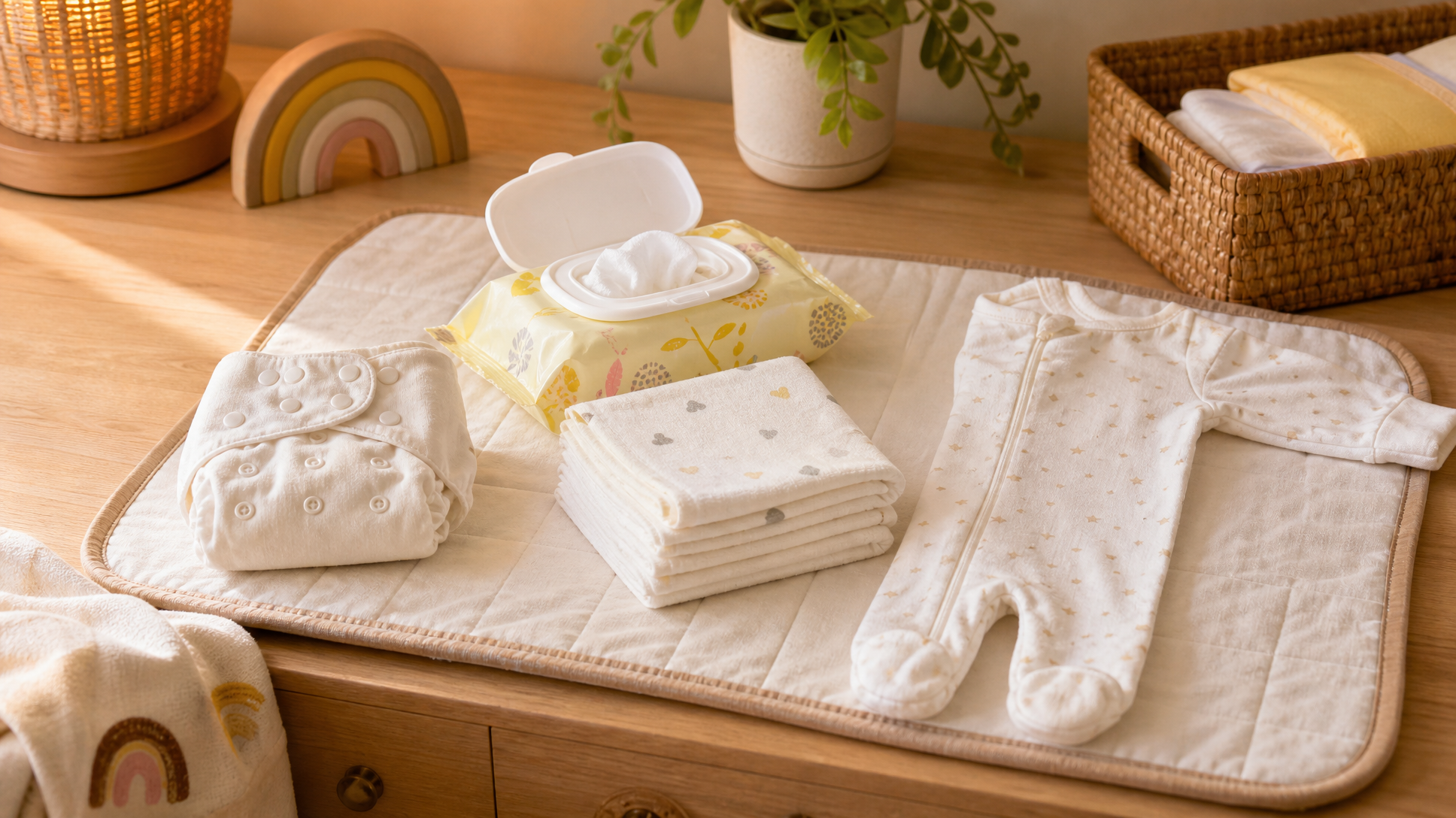
Diapers and wipes — more than you think. Newborns go through diapers at a rate that genuinely surprises most first-time parents. Have a solid stash at home. Don't buy too many in newborn size before birth though — some babies skip straight to size 1.
A changing mat or station. You'll be changing diapers on every surface in your home before long, so having a dedicated, easy-to-clean spot matters. A changing mat you can place anywhere is often more practical than a fixed table in those early chaotic days.
Swaddle blankets. Newborns are used to being tightly held. A good swaddle — whether a traditional muslin blanket or a zip-up swaddle sack — can be the difference between a baby who settles and one who startles awake every few minutes. Have two or three so you always have a clean one.
Burp cloths and bibs. In bulk. Feeding is messy from the first day. Bibs and burp cloths disappear into the laundry pile faster than anything else in those early weeks — having plenty on hand means you're not doing emergency washes at midnight.
A baby monitor, if your home needs one. If you're sleeping in a different room from baby or your house has multiple floors, a baby monitor earns its place immediately. If you're in a small apartment and baby is next to you, it can wait.
Bottles and nipples, even if you're breastfeeding. This one's worth having ready even if you plan to exclusively breastfeed. Latching difficulties, supplementing, or a partner taking a night feed — any of these can come up in the first 72 hours. Having a couple of bottles on hand means you're not scrambling.
Week Two and Three: Now You Know Your Baby
By the end of the first week, you'll have learned things no checklist could tell you: whether your baby is a contact napper or will actually sleep flat, whether they're gassy and need a different bottle, whether they love being worn or hate it. This is when you buy the rest — based on your actual baby, not a generic list.
A baby carrier or sling. Some babies want to be held constantly. If yours is one of them, a carrier frees your hands and your sanity. But carriers are personal — the fit, the style, the weight distribution all matter — so waiting until you know your baby's temperament before investing makes sense. Explore baby carriers and slings once you've had a week to assess whether you'll actually use one.
A bouncer or swing. Magical for some babies, useless for others. Genuinely wait on this one. Borrow one if you can for the first couple of weeks before buying.
A baby bathtub. Newborns only need sponge baths until the umbilical cord stump falls off — which typically happens in the first few weeks. A baby bathtub can wait until you're actually ready to do proper baths.
A breastfeeding pillow, if you're nursing. If breastfeeding is going well, a dedicated nursing pillow can make long feeding sessions much more comfortable. If feeding hasn't gone as planned, you may need different support entirely — which is another reason to hold off on some purchases until you're in it.
Developmental toys and activity mats. Your newborn doesn't need toys. They need faces, voices, and sleep. By weeks three and four, some simple black-and-white visual stimulation starts to matter — but don't rush it. Activity mats become genuinely useful around the one-month mark when tummy time begins in earnest.
What You Can Almost Certainly Skip (At First)
A wipe warmer. A diaper pail with a specific refill system. A high chair (your baby won't need one for months). An elaborate white noise machine when your phone already does the job. A full nursery setup if your baby is sleeping in your room.
None of these are bad products. Some of them you'll want eventually. But buying them before your baby arrives just adds to the visual noise of an already overwhelming time — and returns are a hassle when you're sleep-deprived.
The Actual Principle Here
Buy what you need for the moment you're in. Before birth: car seat, sleep space, a few outfits, feeding basics. First days home: diapers, wipes, swaddles, burp cloths. After week one: everything else, based on who your baby actually is.
You don't need to figure it all out before they arrive. You just need to be ready for the first few days — and trust that you'll work out the rest once you're in it.
Find everything on your newborn list in one place — shop Baby Gear and all baby essentials at Cutebabybuy, shipped from the USA to wherever you are.
Frequently Asked Questions
How many newborn outfits do I actually need before the baby arrives?
A small handful — around five to seven sleepers in newborn and 0–3 month sizes — is enough to start. Babies outgrow newborn sizing quickly, sometimes within weeks, so stocking up heavily in that size often means you end up with unworn clothes. Prioritize zip-front sleepers over snap closures for easier nighttime changes.
Do I need a bassinet AND a crib, or will one do?
One safe sleep space is enough to start. Many parents choose a bassinet for the first few months because it's easier to have next to the bed, then transition to a crib. But if budget or space is a concern, a crib from day one works perfectly well too — you don't need both.
What if I'm not sure whether I'll breastfeed or formula feed?
Have a small supply of both ready. A couple of bottles, some formula for emergencies, and basic breastfeeding supplies (nursing pads, nipple cream) cover your bases without overcommitting to either path. Feeding plans change quickly in the first days, and having options removes pressure at an already intense time.
Is a baby monitor necessary for a small apartment?
Probably not essential if your baby is sleeping in your room or you can hear them easily from anywhere in your home. A monitor earns its place in larger homes, multi-story houses, or once baby moves to their own room. It's a reasonable item to hold off on until you know your setup.

