

The day your baby rolls across the mat and heads straight for the coffee table corner is the day baby-proofing stops feeling theoretical. It happens fast — one week they're happily lying on their back, the next they're mobile and curious about every sharp edge, open drawer, and dangling cord in the house.
Most baby-proofing guides hand you a list of 47 items and wish you luck. This one works differently. We've broken it down room by room, so you can close the kitchen door, spend an hour in there, and actually feel done — then move on. Start wherever your baby spends the most time, and work outward from there.
Before You Start: Two Things Worth Knowing
First, get on the floor. Literally crawl around each room at your baby's eye level. You'll immediately spot hazards that are invisible from adult height — a power strip tucked under the sofa, a low cabinet hinge, a gap between the bookshelf and the wall.
Second, baby-proofing isn't a one-time event. What's safe for a four-month-old roller is different from what's safe for a nine-month-old crawler, which is different again for a twelve-month-old who's pulling up on furniture. Plan to reassess every couple of months as your baby's abilities change.
The Living Room
This is usually the first room to tackle because it's where babies spend most of their awake time — and it tends to have the most hazards per square foot.
- Furniture corners and edges. Coffee tables are the classic culprit. Foam corner guards are inexpensive and easy to fit; edge strips cover the longer sides of low tables.
- TV and heavy furniture. Flat-screen TVs tip more easily than people expect. Anchor yours to the wall with a furniture strap, and do the same for any bookcase or shelving unit your baby might eventually try to climb.
- Electrical outlets. Cover unused outlets with plug covers. If you're replacing any anyway, tamper-resistant outlets (which have built-in shutters) are a more permanent fix.
- Cords and cables. Blind cords are a serious strangulation hazard — tie them up high or switch to cordless blinds. Bundle TV and device cables into a cord organizer or run them along the baseboard out of reach.
- Small objects. Coins, remote control batteries, decorative pebbles — anything that fits through a toilet paper tube is a choking risk. Do a low-level scan of every surface and under every cushion.
- Fireplace and hearth. If you have one, a freestanding fireplace gate is worth it. The hearth edge is often at exactly the right height to catch a wobbly baby's head.
The Nursery
You've probably already put more thought into this room than any other — but a few things are easy to overlook once the crib is assembled and the decorations are up.
- Crib safety. Once your baby can push up, remove any bumpers, pillows, or positioners from the crib. The sleep surface should be firm and clear. As they get taller, lower the mattress to the lowest setting before they can pull to standing — not after.
- Changing table. Always keep one hand on your baby during changes, even if they're not rolling yet. A changing mat with raised edges and a safety strap adds a layer of security, but the hand rule still applies.
- Dresser and shelving. Anchor to the wall. A baby who can pull up will absolutely try to climb a dresser drawer.
- Baby monitor placement. Keep the monitor cord — if it has one — well away from the crib. A baby monitor positioned safely across the room gives you eyes on the space without adding a hazard near the sleep area.
- Window blind cords. Same rule as the living room. In the nursery, this is non-negotiable.
- Air quality. Not a proofing item exactly, but if your nursery is on a busy street or you have pets, an air purifier or humidifier can make a real difference to a baby's sleep environment.
The Kitchen
Kitchens are high-risk rooms — hot surfaces, sharp objects, heavy appliances, and cleaning products all in one place. The goal here isn't to make the kitchen off-limits forever, but to buy yourself time while your baby is in the early crawling and cruising stage.
- Cabinet and drawer locks. Magnetic cabinet locks are harder for toddlers to defeat than the spring-loaded clip style. Prioritize the cabinets under the sink (cleaning products), the one with the knives, and any drawer at pulling-up height.
- Stove knobs. Stove knob covers are cheap and prevent a baby from accidentally turning on a burner while cruising along the counter edge.
- Oven door. Oven doors get surprisingly hot on the outside. An oven door lock is worth adding once your baby is pulling up.
- Refrigerator. A fridge lock isn't always necessary at the crawling stage, but once they're walking and can open it themselves, it becomes a real consideration — mostly to prevent the fridge from becoming a climbing frame.
- Trash can. Move it inside a locked cabinet or get a can with a locking lid. Kitchen trash contains food scraps, broken glass, and packaging — none of which you want explored.
- High chair placement. Position the high chair away from walls and counters your baby could push off from. Always use the harness, every time.
The Bathroom
The bathroom is the one room where the door itself is your first line of defense. A simple hook-and-eye latch at adult height keeps the door closed between uses — and that single step eliminates most bathroom hazards before you've done anything else.
- Toilet lock. Babies are top-heavy and can fall headfirst into a toilet. A toilet seat lock is a simple fix.
- Medications and toiletries. Move everything — vitamins, over-the-counter medications, razors, nail scissors — to a high shelf or a locked cabinet. Child-resistant caps are not childproof.
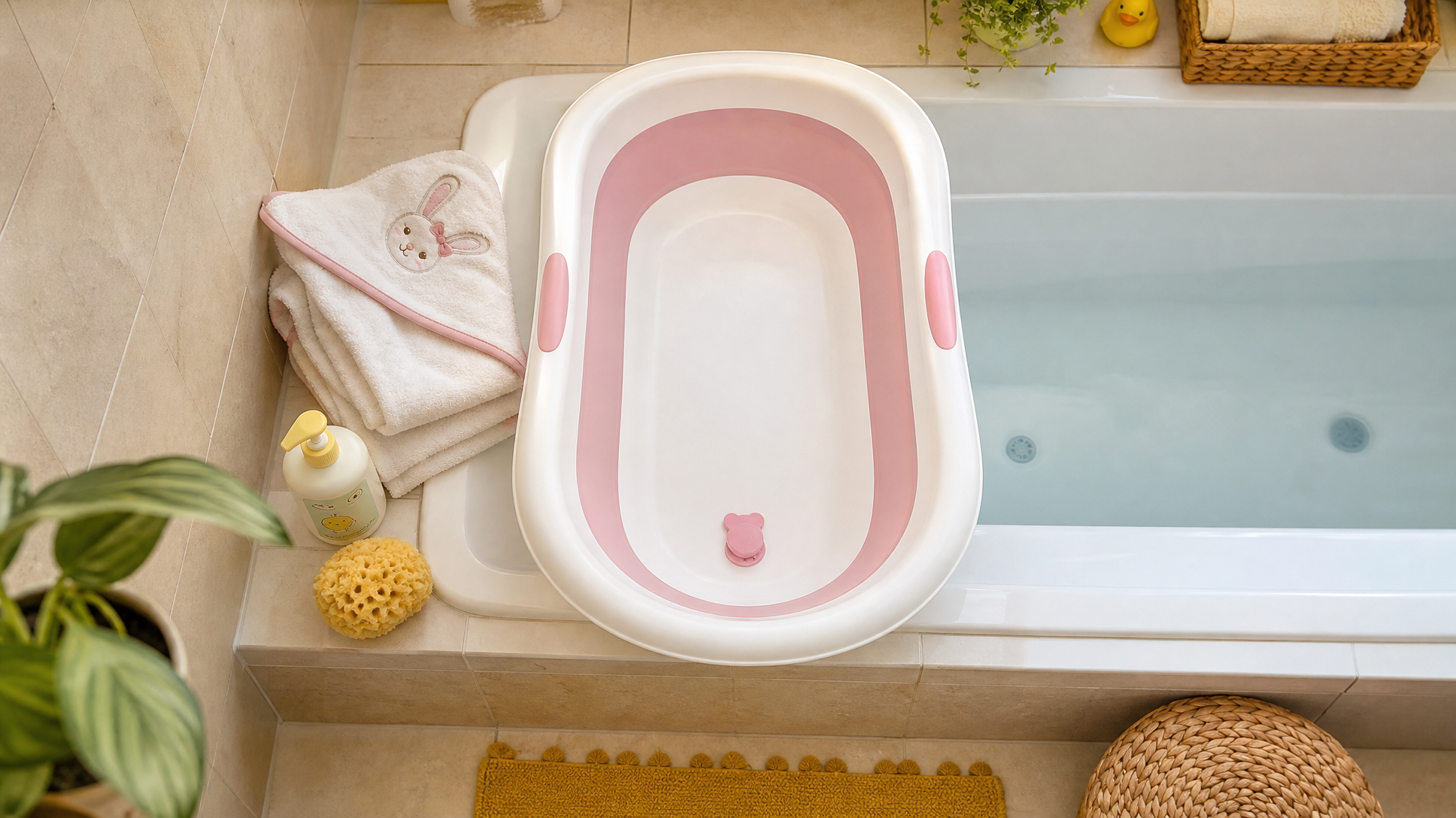
- Bath time. Never leave a baby or toddler alone in the bath, even for a second. A baby bathtub or bath seat provides support and keeps your baby in a stable position, but it doesn't replace supervision.
- Hot water. Set your water heater to no higher than 120°F (49°C) to reduce the risk of scalding. Always test bath water with your elbow or wrist before putting your baby in.
- Non-slip mat. Inside the tub and on the floor outside it. Both.
- Faucet cover. A soft cover over the tub spout protects against head bumps during bath time.
Stairs and Hallways
If your home has stairs, pressure-mounted gates work at the bottom (to keep babies from climbing up); hardware-mounted gates — screwed directly into the wall studs — are required at the top, where a fall would be serious. Don't use a pressure-mounted gate at the top of stairs.
Hallways are usually lower-risk, but check for any doors that open into a space where a crawling baby could be caught behind them, and consider door pinch guards on interior doors.
A Note on Timing
The ideal time to baby-proof is a month or two before your baby reaches each new mobility milestone — not the day after. If your baby is four months old and not yet rolling consistently, now is the right moment to walk through the living room and nursery. Don't wait until they're already mobile to start the kitchen.
The CDC tracks developmental milestones that can give you a general sense of when most babies reach rolling, sitting, crawling, and walking — useful as a planning guide, though every baby moves at their own pace.
Baby-proofing doesn't have to be a weekend project that consumes your entire Saturday. One room at a time, starting with where your baby is right now, is exactly the right approach.
When you're ready to sort out the gear side of things — from changing mats and bath seats to baby monitors and carriers — Cutebabybuy carries a wide range of baby gear and nursery essentials, all shipped from the USA. Stock up on what you need, one room at a time.
Frequently Asked Questions
At what age should I start baby-proofing my home?
Start before your baby reaches each new mobility milestone, not after. For most families, that means doing the nursery and living room around the three-to-four month mark, and tackling the kitchen and bathroom as your baby approaches crawling — typically somewhere between six and ten months, though every baby develops at their own pace.
What's the single most important baby-proofing step I can take right now?
If your baby is already mobile, anchor your furniture first. Tip-overs from unsecured bookshelves, dressers, and TVs are one of the most common causes of serious injury in toddlers — and it's a fix that takes about fifteen minutes per piece of furniture. After that, prioritize cabinet locks in the kitchen and bathroom door access.
Do I need to baby-proof every room at once?
No — and trying to do everything at once usually means nothing gets done properly. Start with the rooms your baby actually spends time in right now, and work outward. Keeping certain rooms (like the bathroom and kitchen) simply off-limits with a door latch buys you time to tackle them properly when you're ready.
Are pressure-mounted baby gates safe for the top of stairs?
No. Pressure-mounted gates can be pushed out of position by a child's weight or force, which makes them unsafe at the top of a staircase. Use a hardware-mounted gate — one that screws directly into wall studs — at the top of any stairs. Pressure-mounted gates are fine at the bottom of stairs or in doorways where a fall isn't a risk.

