

Most parents know the basics. Fewer know the details that actually matter.
You've heard "back to sleep" a hundred times before your baby even arrives. You nodded at the pediatrician's office. You probably have it written in a notebook somewhere. But then you're standing in the nursery at 2 a.m., wondering if that fitted sheet is too loose, whether the pack-n-play mattress pad you bought counts as a safe surface, and why your aunt keeps insisting the crib bumper is fine because she used one with all four of her kids.
The American Academy of Pediatrics (AAP) has published safe sleep guidelines for decades, and they're updated regularly as new research comes in. The problem isn't that the guidelines don't exist — it's that most parents only ever hear a fragment of them. This post walks through what the current recommendations actually cover, category by category, so you can set up your baby's sleep space with real confidence instead of anxious guessing.
The Sleep Position Rule (and Why It's Non-Negotiable)
Back sleeping for every sleep, every time, until your baby can roll both ways independently. That's the AAP's position, and it hasn't changed. The risk reduction tied to back sleeping is one of the most well-documented findings in infant safety research — this isn't a precaution that gets quietly revised away.
Side sleeping doesn't count as a safe alternative. Neither does stomach sleeping, even if your baby seems to sleep more soundly that way. Once a baby can roll from back to front and back again on their own, you don't need to reposition them in the night — but until that milestone, you do.
The Sleep Surface: This Is Where Most Parents Get It Wrong
The guideline isn't just "put them on their back." It's "put them on their back on a firm, flat, non-inclined surface." Each of those words is doing real work.
Firm means the surface shouldn't contour or sink under your baby's weight. A mattress that feels comfortable to an adult hand isn't necessarily firm enough for a newborn. If you press your palm into the mattress and it bounces back quickly with little give, that's a good sign. If it cradles your hand, it's too soft.
Flat rules out inclined sleepers, rockers, bouncers, and any product that holds a baby at an angle — even a slight one. The AAP has been explicit that inclined sleep products are not safe for unsupervised sleep, regardless of how they're marketed. A baby's airway is not yet strong enough to maintain a safe position on an incline during sleep.
Non-inclined is worth calling out separately because it catches products that look flat but aren't quite. Always check the actual angle, not just the product's category name.
The sleep surface also needs to meet safety standards — this applies whether you're using a full-size crib, a bassinet, or a pack-n-play. Each of these is a legitimate safe sleep option when used correctly. A couch, armchair, adult bed, or car seat (outside a moving vehicle) is not.
Bedding: Less Is Genuinely More
The rule on bedding is stark and worth saying plainly: the sleep space should be empty. No pillows. No positioners. No rolled blankets. No bumpers — including the mesh "breathable" ones, which the AAP also advises against. No sleep positioners marketed to prevent rolling. No stuffed animals, however small.
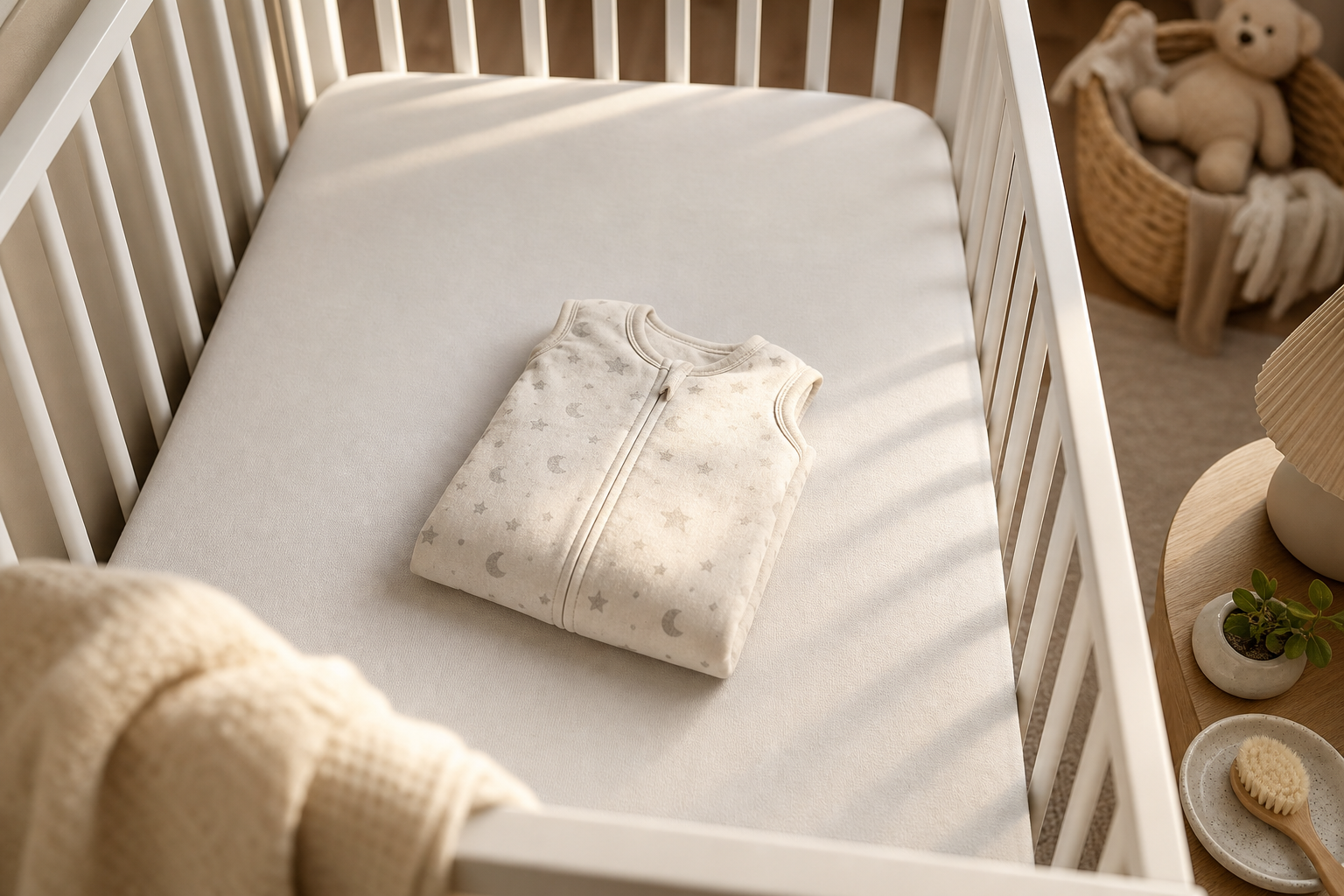
What belongs in the crib: a firm mattress, a fitted sheet designed specifically for that mattress, and your baby. That's it.
This is the category where well-meaning gifts cause the most confusion. A beautiful crib set with a quilt, a bumper, and a decorative pillow looks like a complete nursery — and it's also a sleep space that doesn't meet current guidelines. The quilt goes on the wall as décor. The bumper goes in a drawer. The sleep space stays bare.
For warmth, the AAP recommends a wearable blanket or sleep sack instead of a loose blanket. These keep your baby warm without any loose fabric near their face.
Pack-N-Plays and Bassinets: What Counts as Safe Inside Them
A common question: can you add a mattress pad or extra cushioning to a pack-n-play? The answer is no — and it matters. Pack-n-plays are designed and tested with their own built-in sleep surface. Adding any additional padding on top changes the firmness and potentially the safety profile of that surface. Use only the mattress or pad that came with the unit, or one specifically made and certified for that exact model.
Bassinets follow the same logic. They're a safe option for the first few months, but they have weight and developmental limits — once your baby can push up on their hands and knees, it's time to transition to a crib. Check the manufacturer's guidelines for the specific bassinet you're using.
When you're shopping for bedding and mattresses, look for options that are designed specifically for infant sleep spaces — not adapted from adult bedding. The fit matters as much as the firmness: a fitted sheet should have no slack, no excess fabric that could bunch up.
Room Sharing vs. Bed Sharing: The Distinction That Gets Blurred
The AAP recommends room sharing — having your baby sleep in your room in their own separate sleep space — for at least the first six months, ideally the first year. This is different from bed sharing, which the AAP advises against.
Room sharing keeps your baby close for feeding and monitoring without the risks that come with sharing an adult sleep surface. Adult mattresses, pillows, and bedding are not designed with infant safety in mind. The risk of suffocation on a soft adult mattress, or from a sleeping adult rolling over, is real and documented.
If you fall asleep while feeding your baby in bed, that's a common and understandable thing — but it's worth having a plan for it. Keep the sleep space close enough that returning your baby to their own surface is quick and easy, even at 3 a.m. with your eyes half open.
Products That Conflict With the Guidelines (Even Popular Ones)
A few categories worth naming directly, because they're widely sold and widely used:
- Inclined sleepers and rockers — not safe for unsupervised sleep, regardless of angle.
- Crib bumpers (padded or mesh) — not recommended. The AAP removed any endorsement of mesh bumpers in recent updates.
- Sleep positioners and wedges — not recommended. They create an uneven surface and can restrict movement.
- Weighted sleep sacks or swaddles — the AAP has flagged concerns about weighted products for infant sleep; check current guidance before purchasing.
- Dock-a-Tot style loungers — designed for supervised lounging, not for sleep. The surface is too soft and the sides are too close to the baby's face.
This isn't about being alarmist — it's about knowing that "sold in baby stores" and "meets safe sleep guidelines" are not the same thing. Marketing language around infant sleep can be misleading, and the safest approach is to cross-reference any product against the AAP's current recommendations before using it for sleep.
Temperature and Environment
Keep the room at a comfortable temperature — not so warm that your baby is sweating, not cold enough that you'd need a heavy blanket to compensate. Overheating is a risk factor, which is another reason sleep sacks in the right tog rating for the season beat loose blankets.
Pacifier use at sleep time is actually associated with a reduced risk in the research — you don't need to keep it in once your baby is asleep, and you don't need to reinsert it if it falls out. If you're breastfeeding, many sources suggest waiting until breastfeeding is well established before introducing a pacifier, though this is worth discussing with your own pediatrician.
Setting Up the Space With Confidence
Safe sleep doesn't require the most expensive crib or the most elaborate nursery setup. It requires the right surface, the right bedding (which mostly means no bedding), and the right position — consistently, every time your baby sleeps, whether it's a nap or overnight.
The nursery can still be beautiful. A well-chosen fitted sheet in a soft print, a quality mattress that fits the crib properly, and a sleep sack in a sweet pattern — that's a sleep space that looks lovely and follows the guidelines. You don't have to choose between safe and sweet.
Browse Cutebabybuy's bedding and mattress collection — curated for newborn sleep spaces and shipped from the USA — to find fitted sheets, mattresses, and sleep-safe essentials that make it easier to get the setup right from day one.
Frequently Asked Questions
Can my baby sleep in a pack-n-play instead of a crib?
Yes — a pack-n-play with its original, manufacturer-provided sleep surface is considered a safe sleep space by the AAP, as long as it meets current safety standards. The key is to use only the included mattress or pad and not add any extra cushioning on top, which can compromise the firmness and safety of the surface.
Are mesh crib bumpers safe?
The AAP no longer recommends any crib bumpers, including mesh or "breathable" versions. The concern is that any bumper adds material to the sleep space that isn't necessary and could pose a risk. The safest crib is one with a firm, fitted sheet and nothing else inside it.
What should my baby wear to sleep if I can't use a blanket?
A wearable blanket or sleep sack is the recommended alternative to loose blankets. These zip or snap around your baby and keep them warm without any loose fabric near their face. Look for one appropriate to the room temperature — sleep sacks come in different weights for different seasons.
When can my baby safely sleep on their stomach?
Once your baby can roll from back to front and back again independently, you don't need to reposition them if they roll onto their stomach during sleep. Until they can do both directions on their own, always place them on their back to start every sleep. The milestone varies by baby, so watch for it rather than going by age alone.

