

You're standing in the toy aisle — or more likely, scrolling through product listings at 11pm — and every other toy for your 1-year-old says something like "eco-friendly," "natural," or "sustainably made." It sounds reassuring. It's supposed to. But after the third or fourth product makes the same claim with zero explanation, a reasonable question starts forming: what does any of this actually mean?
The honest answer is: it depends entirely on the brand and how loosely they're using the term. "Eco-friendly" is not a regulated label for toys in the US. Anyone can print it on a box. That doesn't mean every claim is hollow — genuinely sustainable baby toys do exist, and they're worth seeking out — but it does mean you need a slightly sharper eye than the packaging assumes you have.
Why It Matters More for 1-Year-Olds Specifically
At 12 months, babies are mouthing everything. A toy doesn't just get played with — it gets chewed, sucked on, and dragged across the floor before going straight back into the mouth. That's developmentally normal, and it means the materials in a toy have a more direct path to your child than at almost any other age.
This is the core reason material quality matters: not just environmental impact, but what your baby is actually putting in their mouth. The two concerns — safety and sustainability — overlap more than most toy marketing lets on.
Materials That Actually Mean Something
When a toy is genuinely made with sustainability in mind, the material is usually the first honest signal. Here's what to look for:
Solid Wood (Not Composite or MDF)
Real solid wood — beech, maple, rubberwood — is durable, biodegradable, and when finished with non-toxic paints or natural oils, genuinely safer for mouthing than most plastics. The key word is solid. Composite wood or MDF (medium-density fiberboard) can contain adhesives and resins you don't want near a baby's mouth. If the listing doesn't specify the wood type, that's worth noting.
Natural Rubber
Toys made from natural rubber (tapped from rubber trees) are a solid choice for teethers and soft toys. Natural rubber is biodegradable and free from the synthetic additives found in PVC. Watch out for toys labeled simply "rubber" without the "natural" qualifier — synthetic rubber is a different material entirely.
Organic Cotton and Wool
For soft toys and stuffed animals, organic cotton means the fabric was grown without synthetic pesticides. It's softer on sensitive skin and a more responsible choice than conventional cotton. Look for this in plush toys, fabric blocks, and activity mats.
BPA-Free and Phthalate-Free Plastics
This one requires a bit of nuance. "BPA-free" is now standard on most baby products in the US — it's a baseline, not a premium feature. A toy that leads with "BPA-free" as its main eco credential is doing the minimum. That said, for toys that do use plastic (bath toys, stacking cups), BPA-free and phthalate-free are the right things to confirm — just don't mistake them for a sustainability claim.
Certifications Worth Recognizing
Because "eco-friendly" is unregulated, third-party certifications do some of the heavy lifting. These are the ones that carry real weight:
- ASTM F963 — The US standard for toy safety. Not an eco certification, but a baseline safety requirement. Any toy sold in the US should meet this.
- EN71 — The European toy safety standard, often seen on imported toys. Covers chemical safety, mechanical safety, and flammability.
- FSC (Forest Stewardship Council) — For wooden toys, FSC certification means the wood was sourced from responsibly managed forests. This is one of the more meaningful sustainability markers you'll see on toy packaging.
- OEKO-TEX Standard 100 — For fabric toys and soft goods, this certification tests for harmful substances. A plush toy with OEKO-TEX certification has been tested against a list of restricted chemicals.
- GOTS (Global Organic Textile Standard) — A stricter standard for organic textiles, covering the entire supply chain from fiber to finished product.
If a toy claims to be eco-friendly but carries none of these (or similar recognized third-party certifications), the claim is essentially self-reported. That's not automatically a dealbreaker, but it means you're taking the brand's word for it.
The Green Packaging Problem
Here's the pattern that trips up even careful shoppers: a toy arrives in kraft paper packaging printed with leaves and earthy tones, the listing uses words like "planet-conscious" and "thoughtfully made" — and the toy itself is a standard piece of colored plastic with no material information provided.
Sustainable packaging is a real thing and not worthless. But packaging is not the product. If the eco story stops at the box, the toy itself hasn't changed. A wooden toy in plastic packaging is still a wooden toy. A plastic toy in recycled cardboard is still a plastic toy.
The question to ask is always: what is the toy made of, and what's the evidence for the claim? If a listing can't answer the first question clearly, it probably can't answer the second one either.
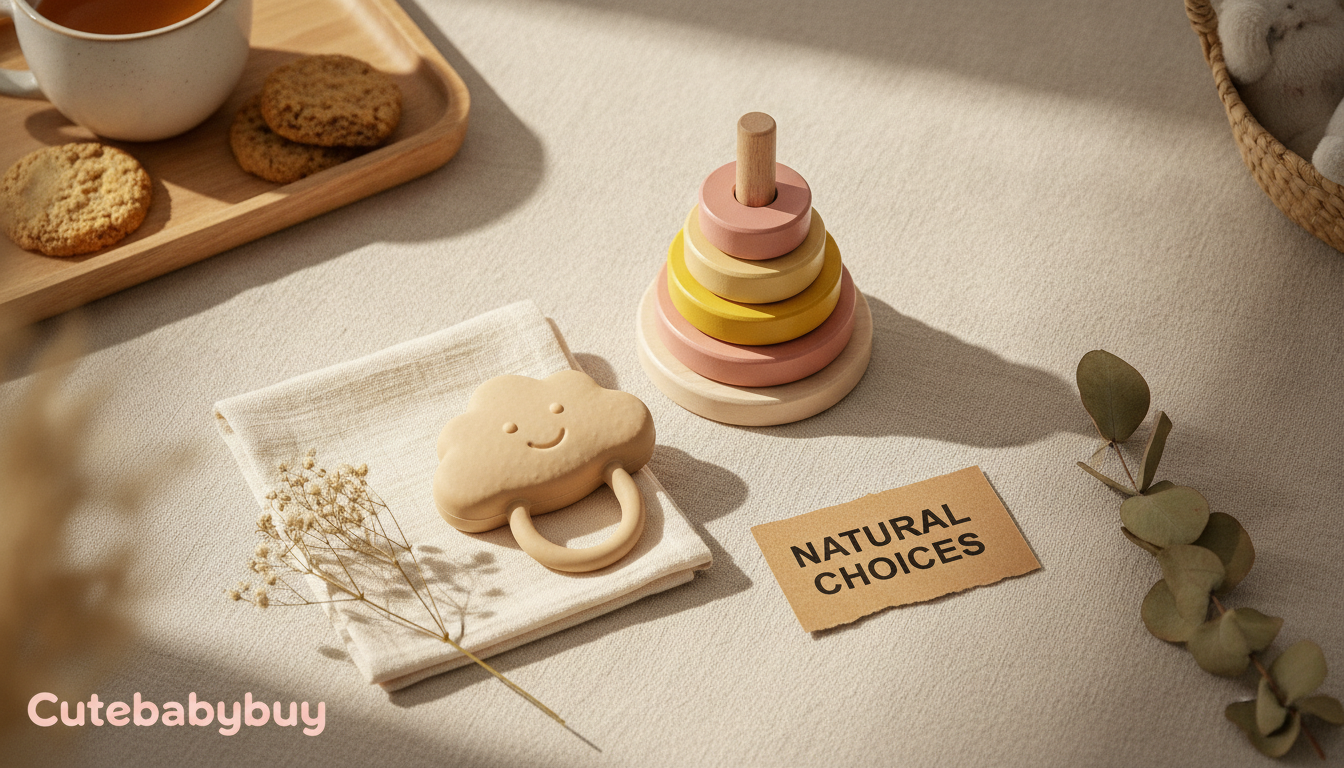
What 1-Year-Olds Actually Need From a Toy
Sustainability matters, but so does developmental fit. A toy that's beautifully made but completely wrong for a 12-month-old isn't a good buy regardless of its materials. At this age, the play patterns are pretty consistent: banging, stacking, dropping, pulling, and beginning to sort by shape or color.
The best toys for this stage tend to be simple. Stacking rings, shape sorters, push-and-pull toys, soft blocks, and basic cause-and-effect toys (press a button, something happens) are all developmentally on point. These categories happen to translate well into wood and natural materials — which is part of why wooden developmental toys have such a long track record.
Complexity isn't a virtue at this age. A toy with fifteen functions and flashing lights isn't more stimulating — it's often just more overwhelming. Simpler materials, simpler play.
A Practical Checklist Before You Buy
- What is it made of? The listing should name the material specifically — not just "natural materials" or "eco-friendly components."
- Are there third-party certifications? FSC for wood, OEKO-TEX or GOTS for fabric, ASTM F963 for general toy safety.
- Is the paint or finish specified? For wooden toys, water-based, non-toxic paint or natural oil finishes are what you want.
- Is the eco claim about the toy or the packaging? Read carefully — these are easy to conflate.
- Is it age-appropriate? Check the manufacturer's age recommendation and look at what the toy actually asks a child to do.
None of this takes long once you know what you're looking for. Most good listings answer these questions upfront because the brands behind them are proud of the answers.
The Bottom Line
"Eco-friendly" on a baby toy is a starting point for a conversation, not the end of one. The brands worth trusting are the ones that show their work — naming materials, citing certifications, and being specific about what makes their product a better choice. The ones that rely on leaf graphics and warm language without substance are selling you a feeling, not a fact.
For your 1-year-old, the sweet spot is a toy that's developmentally right, made from materials you can verify, and built to last longer than a season. Those toys exist, and they're worth a little extra research to find.
Browse developmental toys for 1-year-olds at Cutebabybuy — and if you're thinking about what your baby wears while they play, our guide on dressing a baby for every season covers the layering basics from 0–24 months.
Frequently Asked Questions
Is "non-toxic" the same as "eco-friendly" for baby toys?
Not quite. "Non-toxic" refers to the safety of materials for the child — paints, finishes, and plastics that won't harm your baby if mouthed or handled. "Eco-friendly" is a broader claim about environmental impact, including how materials are sourced, manufactured, and disposed of. A toy can be non-toxic without being sustainably made, and vice versa. For a 1-year-old, you want both — so it's worth checking for each separately rather than assuming one implies the other.
Are wooden toys always safer than plastic ones for babies?
Not automatically. A solid wood toy finished with non-toxic, water-based paint is generally a great choice for mouthing-age babies. But wood quality varies — composite wood and MDF can contain adhesives you'd want to avoid, and a poorly finished wooden toy can splinter. Plastic toys made from BPA-free, phthalate-free materials and meeting ASTM F963 standards are also safe. The material matters less than whether the specific toy has been made and tested responsibly.
What does FSC certification mean on a wooden toy?
FSC stands for Forest Stewardship Council. When you see FSC certification on a wooden toy, it means the wood used was sourced from forests that are managed to meet environmental and social standards — covering things like biodiversity, worker rights, and responsible harvesting. It's one of the more meaningful sustainability certifications you'll encounter on toy packaging, because it's verified by an independent third party rather than self-reported by the brand.
How do I know if a toy is developmentally appropriate for a 1-year-old?
Start with the manufacturer's age recommendation — it accounts for safety (small parts, choking hazards) as well as developmental fit. Beyond that, think about what a 12-month-old actually does: banging, stacking, dropping, basic sorting, and simple cause-and-effect. Toys that support these actions — stacking rings, shape sorters, push-pull toys, soft blocks — are well-matched to this stage. If a toy requires skills a 1-year-old doesn't have yet (fine motor precision, symbolic thinking), it'll sit unused regardless of how well it's made.

