

The Label That's Everywhere but Rarely Explained
You're standing in the baby clothing aisle — or scrolling through a product page at 11 p.m. — and you see it again: organic. It's on onesies, sleep sacks, swaddle blankets, and tiny socks. It usually comes with a price bump. And almost nobody explains what it actually means for a piece of clothing on your baby's body.
So let's fix that. This isn't a case for or against organic baby clothes — it's a practical guide to understanding what the labels require, which situations genuinely call for them, and where you can skip the premium without any guilt.
What 'Organic' Actually Means on a Clothing Label
When a baby garment is labeled organic, it typically refers to the way the raw fiber — most often cotton — was grown. Organic cotton is farmed without synthetic pesticides, herbicides, or genetically modified seeds. That's the agricultural side of the story.
But here's where it gets more nuanced: how a fiber is grown is different from how it's processed into fabric and then into a finished garment. Cotton can be organically grown and then treated with conventional dyes, bleaches, or finishing chemicals during manufacturing. A tag that just says "organic cotton" doesn't automatically tell you anything about what happened after the farm.
This is why certifications exist — and why they're worth understanding before you pay extra for them.
The Certifications That Actually Matter
Two standards come up most consistently in baby clothing, and they're not the same thing.
GOTS (Global Organic Textile Standard)
GOTS is widely considered the most comprehensive certification for organic textiles. It covers the entire production chain — from the raw fiber through dyeing, finishing, and manufacturing. To carry a GOTS label, a garment must meet organic fiber requirements and restrict the use of harmful chemicals throughout processing. For baby clothing specifically, this is the certification most worth looking for, because it addresses what touches your baby's skin at every stage of production.
OEKO-TEX Standard 100
OEKO-TEX Standard 100 works differently. It doesn't certify how the fiber was grown — it tests the finished product for harmful substances. A garment with this label has been tested and confirmed to be free from a defined list of harmful chemicals at levels that could affect human health. Crucially, an OEKO-TEX certified garment doesn't have to be made from organic fiber at all; it just has to pass the substance testing.
Neither is "better" in an absolute sense — they answer different questions. GOTS tells you about the supply chain. OEKO-TEX tells you about the finished item on the shelf.
What "100% Organic Cotton" Without a Certification Means
Honestly? Not as much. A brand can make this claim based on the fiber sourcing alone, with no third-party verification of the growing practices or the downstream processing. It's not necessarily a lie, but it's also not a guarantee. If you're paying a significant premium, a third-party certification is what gives that claim real weight.
When Organic Baby Clothes Genuinely Make a Difference
Your baby's skin is thinner and more permeable than adult skin, and newborns especially spend most of their time in direct contact with fabric — sleepsuits, swaddles, bodysuits. That's the honest case for being more selective about what you put closest to them.
Here's a practical framework for where organic or certified options earn their price:
- Sleepwear and bodysuits. These are worn for long, uninterrupted stretches directly against skin. If you're going to prioritize certified fabrics anywhere in your baby's wardrobe, this is it.
- If your baby has sensitive skin or eczema. Conventional textile processing can involve residual chemicals that irritate reactive skin. A GOTS-certified or OEKO-TEX-tested garment reduces that variable meaningfully.
- Newborn stage. In the first few weeks, your baby's skin barrier is still developing. Keeping irritants low during this window is a reasonable precaution, not paranoia.
- Items that go in the mouth. Bibs, teething cloths, and anything a baby is likely to chew on are worth treating with the same care as sleepwear.
When You Can Comfortably Skip the Premium
Baby clothing gets stained, outgrown, and replaced at a pace that can feel almost comical in the early months. Spending top dollar on every item isn't realistic — and for some categories, it's genuinely unnecessary.
- Outerwear and layering pieces. A jacket worn over two other layers isn't in the same direct-skin contact category as a onesie. Conventional options are fine here.
- Occasion outfits worn briefly. The little dress or outfit worn for an hour at a family gathering doesn't need to be GOTS-certified.
- Sizes your baby will blow through in weeks. In the newborn-to-three-month window especially, babies grow so fast that buying a full organic wardrobe at each stage is a significant spend for very short use. Prioritize the key items (sleepwear, bodysuits) and be more relaxed about the rest.
Conventional baby clothes that are washed before first use — which you should do regardless — remove most surface residues and are worn safely by the vast majority of babies without any issue. The organic premium is about reducing exposure at the margins, not about a binary safe-versus-unsafe divide.
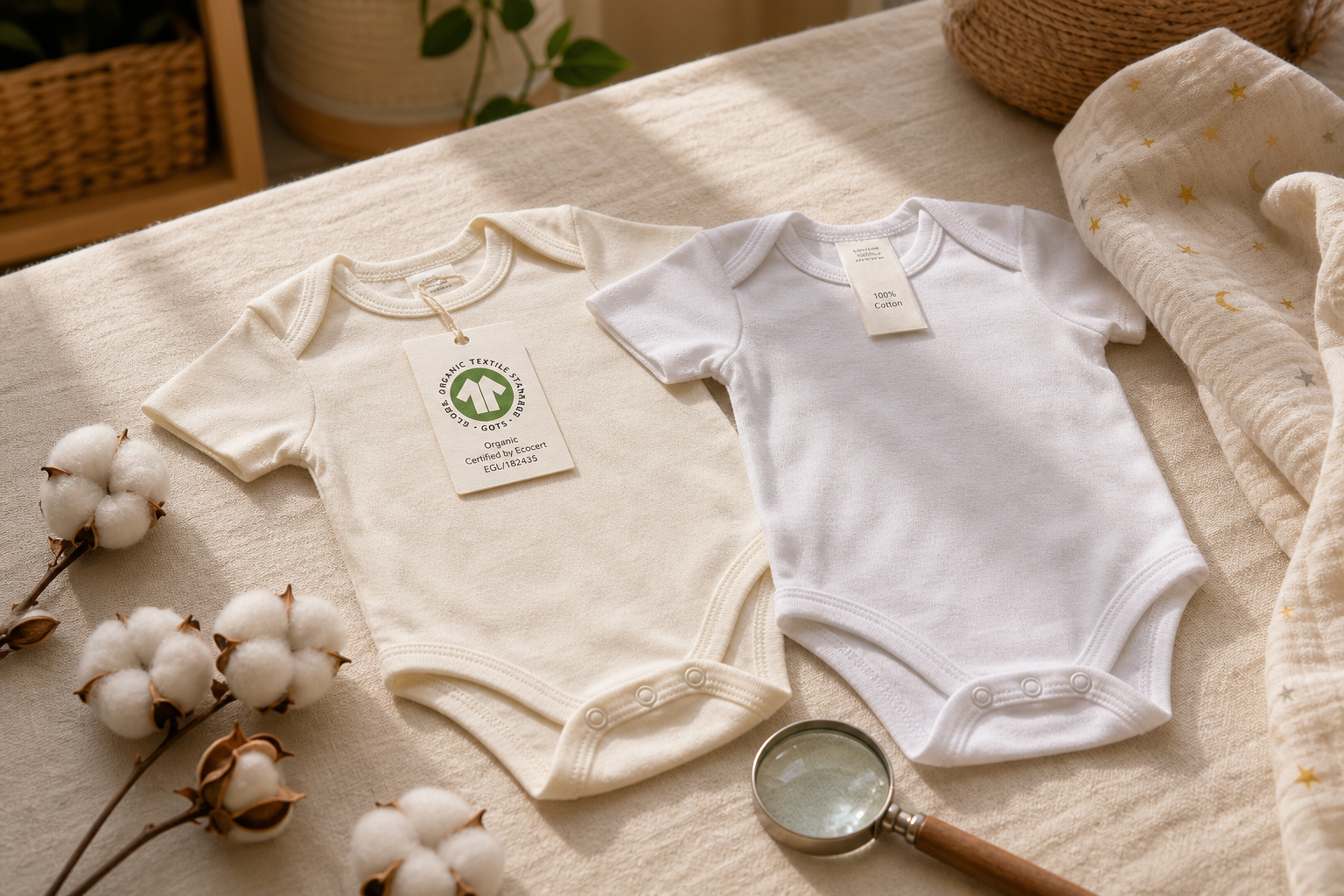
One More Thing: 'Natural' Is Not the Same as 'Organic'
This trips a lot of parents up. "Natural fiber" just means the fabric comes from a plant or animal source — cotton, bamboo, wool, linen. It says nothing about how it was grown or processed. Bamboo, for example, is often marketed as eco-friendly and skin-friendly, but most commercial bamboo fabric goes through an intensive chemical process to become the soft fabric you feel. A bamboo garment without a processing certification isn't automatically gentle.
The label to trust is the third-party certification, not the marketing language around it.
A Simple Decision Rule
If you want a shortcut: prioritize certified fabrics for sleepwear, bodysuits, and anything worn directly against skin for long periods — especially in the newborn stage or if your baby has reactive skin. For everything else, a well-washed conventional garment is a reasonable choice, and your budget is better spent on the items that matter most.
You don't have to go all-organic to be a thoughtful parent. You just have to know which pieces are worth the extra care.
Ready to find options that fit both your priorities and your budget? Browse our baby clothing range at Cutebabybuy — we carry options across price points for every stage, from newborn through toddler. And if you're still figuring out what your baby actually needs to wear in each season, our guide on how to dress a baby for every season is a good next read.
Frequently Asked Questions
Is GOTS certification the same as OEKO-TEX?
No — they certify different things. GOTS covers the entire supply chain from fiber farming through manufacturing, requiring organic inputs and restricting harmful chemicals at every stage. OEKO-TEX Standard 100 tests the finished garment for harmful substances but doesn't require organic fiber. Both are legitimate and worth looking for, but they answer different questions about the product.
Does washing conventional baby clothes before use make them safe?
Washing before first use is always a good idea — it removes surface residues, manufacturing dust, and finishing chemicals that accumulate during production and shipping. It won't eliminate every trace of processing chemicals, but it meaningfully reduces them. Most conventional baby clothes are worn without any issue after a pre-wash.
Is bamboo baby clothing actually better for sensitive skin?
Bamboo fabric is often very soft, which can feel gentle on sensitive skin — but "bamboo" on a label doesn't automatically mean chemical-free. Most bamboo fabric is produced through a process that uses chemical solvents to break down the plant fiber. If sensitive skin is a concern, look for a processing certification like OEKO-TEX Standard 100 rather than relying on the fiber name alone.
Do I need to buy organic clothes for every size as my baby grows?
That's entirely your call, but a practical approach is to prioritize certified options for the categories that matter most — sleepwear and bodysuits — rather than trying to build a fully organic wardrobe at every size. Babies outgrow sizes quickly, especially in the early months, so concentrating your spend on key items is both more realistic and more effective than buying everything organic.
