

The Gear That Promises to Last (And the Gear That Actually Does)
Every new parent hears some version of the same advice: buy things that grow with your baby. It sounds sensible. It sounds economical. And it's the reason "adjustable", "convertible", and "multi-stage" have become some of the most overused words in baby product marketing.
The problem is that "grow-with-me" has no standard definition. A product can slap that phrase on the box for adding a single extra buckle position. Meanwhile, genuinely adaptable gear — the kind that carries a newborn in week one and a curious toddler two years later — tends to be quieter about it, because the features speak for themselves once you know what to look for.
So here's a practical breakdown by category: what real adaptability looks like, what's usually just a label, and what questions to ask before you buy.
Baby Carriers and Slings
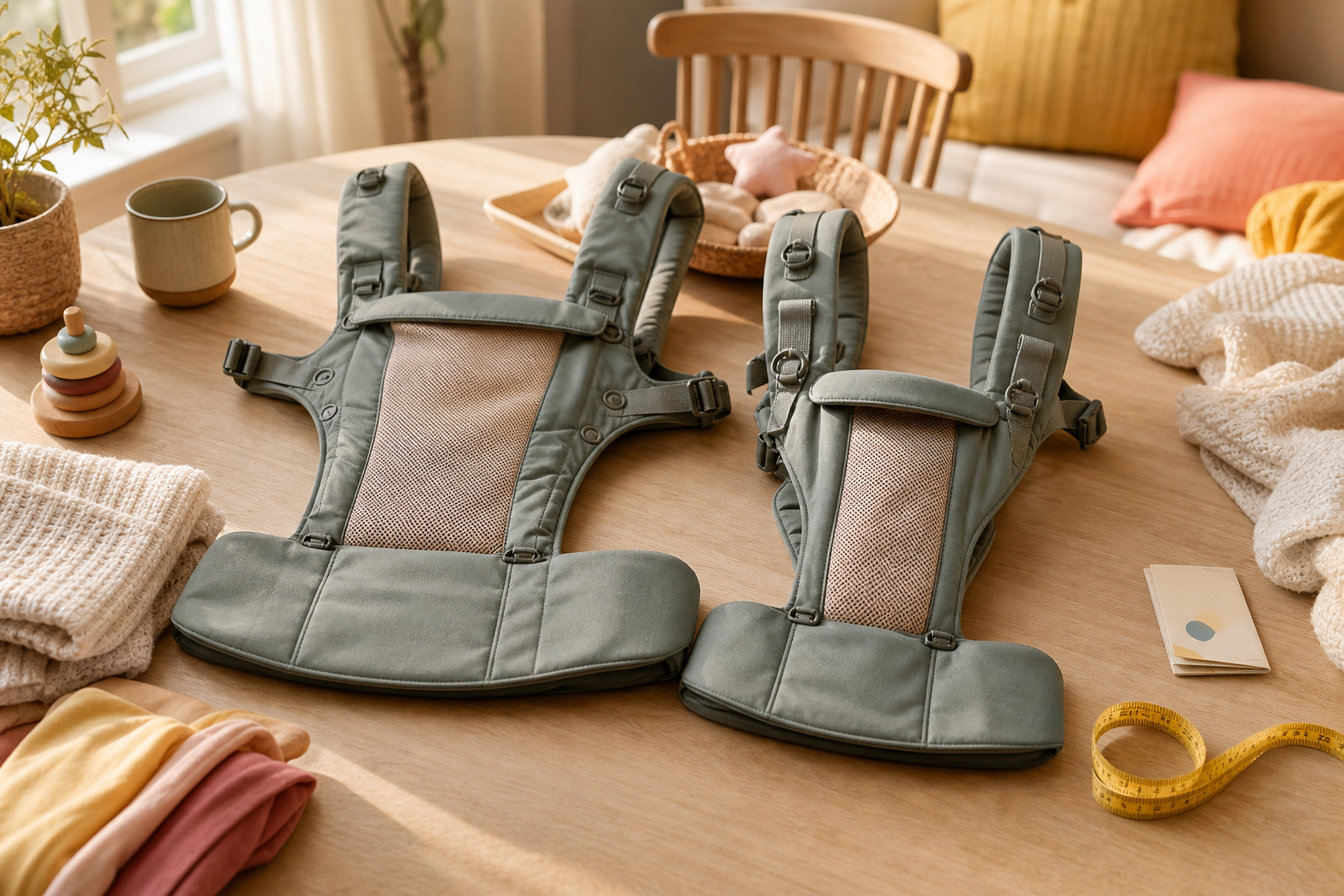
Carriers are where the "grows with baby" claim is most often genuine — and most often abused. A truly adaptable carrier will support at least three distinct carry positions (newborn inward-facing, seated hip carry, and toddler back carry) with a single piece of hardware. The waistband should have a wide weight range built into the structure itself, not just an extender panel sold separately.
What to watch for: if the "newborn" mode requires a separate insert that you're expected to discard after a few months, that's not a grow-with-me carrier — that's two products bundled into one price. The insert should either integrate seamlessly into the carrier's design or not be needed at all.
A genuine signal of longevity: an ergonomic seat that adjusts width to support the M-position (knees higher than bottom) at every stage, from a 7-pound newborn to a 30-pound toddler. That adjustment should be tool-free and quick, because you'll be doing it one-handed while someone screams.
High Chairs
The high chair category is full of products that technically adjust but practically don't. A chair that converts to a booster seat sounds great until you realize the booster version is wobbly on a dining chair and gets abandoned by month three of use.
Real adaptability in a high chair means:
- Footrest that adjusts in height — not just a fixed footrest. Dangling feet are uncomfortable and affect how well a baby eats. As your child grows, the footrest should move with them.
- Recline positions — useful for younger babies who aren't fully upright yet, but only worth paying for if the transition between positions is smooth and secure.
- Removable tray with a dishwasher-safe insert — this isn't about growing with baby, but it's a sign the designer thought about long-term use. A tray that's miserable to clean gets replaced.
- Seat depth and harness adjustments — the harness should have multiple height slots, not just length adjustment. A taller child needs the shoulder straps repositioned upward, not just loosened.
The honest trade-off: chairs that convert all the way to a toddler chair without a tray tend to be bulkier in their primary high-chair phase. If kitchen space is tight, a slimmer dedicated high chair might serve you better than a transformer that takes up the same footprint for five years.
Bouncers and Rockers
This is the category where "grows with baby" is most often a stretch. Most bouncers are genuinely designed for the newborn-to-sitting phase — roughly the first six months — and that's fine. A product that does one stage well is more honest than one that claims five stages but handles none of them comfortably.
That said, some bouncers do extend their usefulness meaningfully. Look for:
- A recline that goes fully flat for a newborn and more upright for a baby who wants to see the world (around 3–4 months).
- A weight limit that reflects actual toddler use, not just a generous number printed on the box. If the seat is visibly too small for a sitting baby, the weight limit is theoretical.
- A frame that converts to a separate toddler rocker or chair — where the seat detaches and sits lower to the ground independently. That's a real second life for the product.
If a bouncer is marketed as "grow-with-me" but the only adjustment is a recline angle, be skeptical. That's a feature, not a lifecycle.
Clothing: Where "Grows With Baby" Gets Complicated
Clothing is the trickiest category because babies grow so fast that even genuinely size-flexible designs have a ceiling. Still, some features meaningfully extend how long a piece gets worn:
- Fold-over cuffs on sleeves and legs — common in newborn sleepers, these let a single garment fit a wider range of lengths. When the baby grows, unfold. Simple, effective.
- Snap or button waistbands that can be let out — worth paying attention to in pants and rompers.
- Generous cut in the body with adjustable straps — particularly in overalls and dungarees, adjustable shoulder straps can add several months of wear.
What doesn't work: "fits 0–12 months" labeling on a garment that's cut like a 3-month size. Sizing claims on clothing are largely unregulated, so fit the actual measurements against your baby rather than trusting the range on the tag.
For a deeper look at dressing babies across different stages and seasons, this layering guide for 0–24 months walks through what actually works at each phase.
The Three Questions to Ask Before Any "Multi-Stage" Purchase
Across every category, these three questions cut through the marketing quickly:
- What specifically changes between stages? If the answer is vague ("it adjusts to your growing baby"), push for the actual mechanism. What part moves? How? Is it tool-free?
- Do the later stages require buying anything extra? Separate inserts, conversion kits, or add-on accessories that cost extra are a sign the "multi-stage" claim is partially a sales funnel, not a design feature.
- How long does the average parent actually use it in stage two? Look for real parent reviews that mention the later stage specifically — not just "great product" reviews that were written at the three-week mark.
Spending More Upfront Isn't Always the Answer
There's a temptation to assume that a higher price automatically means better adaptability. It doesn't. Some of the most genuinely versatile baby gear sits at mid-range prices, while some expensive products are beautifully made but designed for a single, short phase.
The better framing: think about cost-per-month of use. A carrier that works from birth to 24 months and gets used daily has a very different value equation than a premium bouncer that's outgrown at six months. Do the rough math before you decide what "worth it" means.
At Cutebabybuy, the range across strollers, carriers, high chairs, and clothing is built around exactly this kind of long-view thinking — gear you won't be replacing every few months. Browse baby gear built for more than one stage and filter by the categories that matter most to your current stage.
The best grow-with-me product isn't the one with the most stages listed on the box. It's the one you're still using — comfortably, without workarounds — a year after you bought it.
Frequently Asked Questions
What does 'grow-with-me' actually mean for baby products?
It means the product has structural adjustments — not just sizing tweaks — that make it genuinely usable across multiple distinct stages of a baby's development. The term has no regulated definition, so the burden is on you to check what specifically adjusts and how meaningful that adjustment is in practice.
Are convertible high chairs worth the extra cost?
They can be, if the conversion is genuinely useful in your home. A high chair that converts to a stable toddler chair at table height is worth considering. One that converts to a wobbly booster seat you'll never trust on a dining chair probably isn't. Read reviews that specifically mention the converted mode, not just the high chair phase.
How do I know if a baby carrier will fit both a newborn and a toddler?
Look for a carrier with an adjustable seat width that supports the ergonomic M-position at both ends of the weight range, and check that it handles at least three carry positions without requiring a separate insert for the newborn stage. The published weight range should reflect the carrier's actual structure, not just an accessory add-on.
Is it better to buy one grow-with-me item or two dedicated items for different stages?
It depends on the category. For carriers and high chairs, a well-designed multi-stage product usually wins on both cost and convenience. For bouncers and some clothing, a dedicated product that does one stage really well is often a smarter buy than a multi-stage version that compromises on all of them. Think about how much daily use each item will get and over what period.

