

Most parents pick toddler toys the same way: something catches their eye, it looks fun, the reviews are decent, and into the cart it goes. That's not a bad system — but it does mean you can end up with a shelf full of toys that all do roughly the same thing developmentally, while leaving real gaps in what your child gets to practice.
Toddlers between one and three are working on a surprising number of distinct skills at the same time — balance and spatial reasoning, fine motor control, imaginative play, early cause-and-effect thinking. The toys that support each of those look pretty different from one another. Once you know what to look for, shopping gets a lot more intentional (and a lot less random).
Here's a breakdown of the main developmental areas toddlers are building, and the types of toys that actually support each one.
Balance, Spatial Reasoning, and the Satisfying Challenge of Stacking
One of the earliest and most important things toddlers are figuring out is how objects relate to each other in space — what fits on top of what, how weight is distributed, why things fall. Stacking and balancing toys are the classic way to build this, and they work because the feedback is immediate and physical. The tower falls; the child learns something.
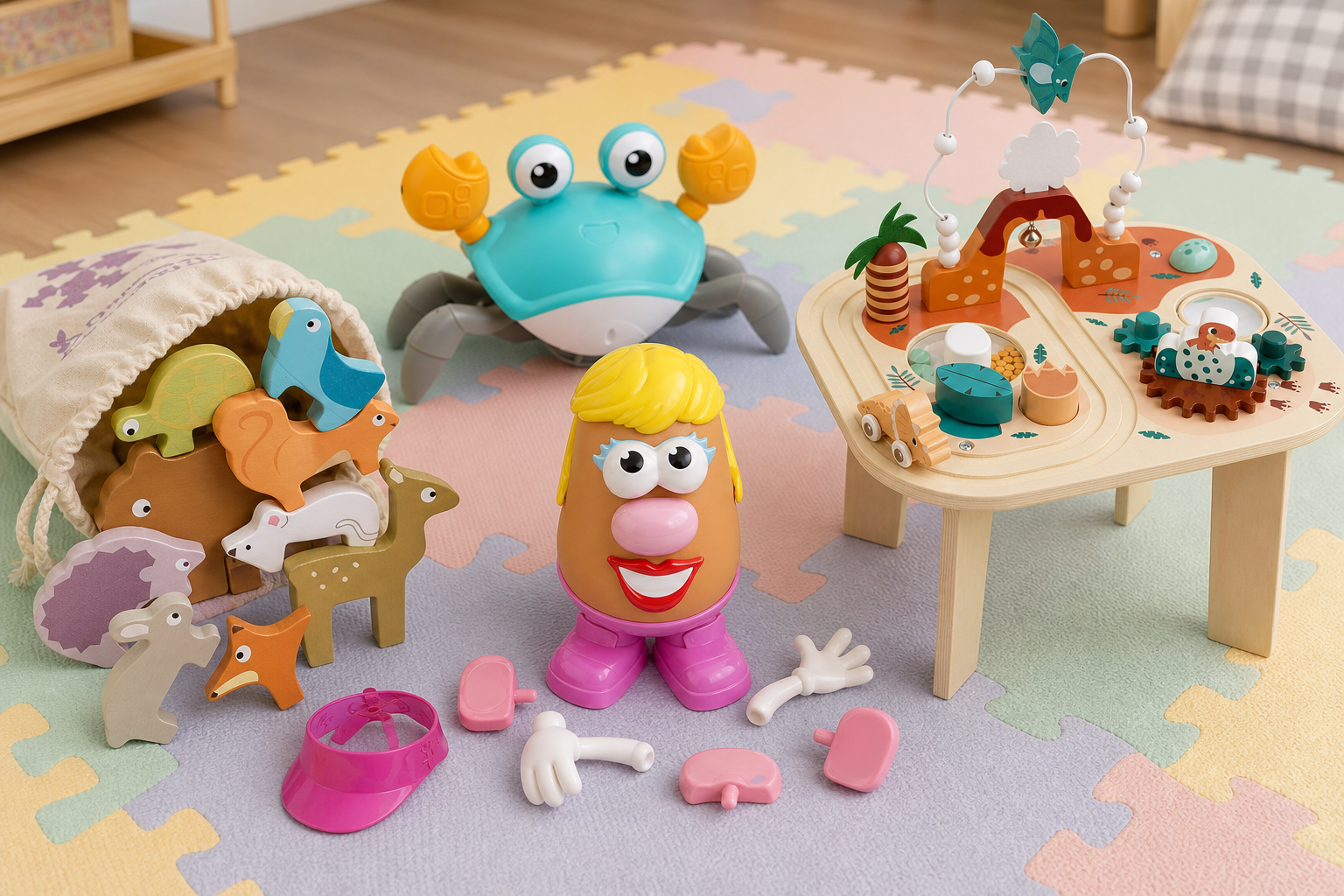
The Le Toy Van Wooden Petilou Forest Stacker Puzzle & Bag is a good example of what this category looks like done well. It's a set of wooden forest animal pieces — a hedgehog, squirrel, deer, fox, bird, and more — that children stack into a balancing tower. Each piece has its own shape and weight, so there's no single "right" way to stack them; kids have to experiment. The natural wood construction and soft, muted paint palette mean it holds up to daily use, and the included drawstring canvas bag makes it genuinely portable — something you can throw in a bag for a visit to grandparents without worrying about losing pieces.
What this toy is really doing: building spatial awareness, hand-eye coordination, patience, and early problem-solving. The fact that it's also beautiful on a shelf is a bonus for parents.
Fine Motor Control and the Power of Mix-and-Match Play
Around 18 months to two years, toddlers start getting a real grip (literally) on smaller objects. Pushing, pulling, inserting, and removing parts are all exercises in fine motor precision — the same foundational dexterity they'll eventually need for writing, drawing, and self-care tasks like buttoning a coat.
The Potato Head Playskool Friends Mrs Classic is one of the most enduring toys in this category for a reason. It comes with 10 accessories that kids mix, match, and rearrange — eyes, nose, mouth, hair, and more — all of which require the kind of deliberate hand control that toddlers are actively developing. The beauty of this toy is that there's no wrong answer. A child who puts the eyes on the bottom and the mouth on top isn't making a mistake; they're making a creative decision, and that distinction matters for building confidence alongside dexterity.
Most parts are also compatible with other Mr. Potato Head and Mrs. Potato Head toys, so if you already have one in the house, the play possibilities expand rather than duplicate.
Cause-and-Effect and Early Movement Motivation
Somewhere between three and nine months, babies start to understand that their actions cause things to happen — and that understanding doesn't stop developing when they become toddlers. Cause-and-effect toys that move, light up, or make sounds reward a child's interaction in a way that keeps them engaged and motivated to keep exploring.
The control future Crawling Crab Baby Toy sits squarely in this category. The teal and orange crab moves and plays music, giving babies and young toddlers something to chase — which is especially useful during tummy time for younger babies, and continues to engage older crawlers and early walkers who are motivated by movement. The "catch me" dynamic encourages babies to reach, lunge, and eventually pull themselves forward, turning play into physical development without any effort on the parent's part.
If you have a baby in the house alongside a toddler, this is also one of those rare picks that genuinely works across a wider age range, from the early months through the first year and a half or so.
For more on what to look for in toys during the first year specifically, our guide to high-quality baby toys and developmental play for ages 0–12 months covers the early stages in detail.
Multi-Skill Play: When One Toy Does Several Things at Once
As toddlers move into the two-to-three age range, the best toys are the ones that grow with them — offering new challenges as skills improve rather than becoming too easy and getting abandoned. Activity tables sit in this sweet spot because they pack multiple types of interaction into a single station.
The Janod Dino Dinosaur Activity Table is a standout here. Built from wood with a dinosaur-world theme, it includes a bead maze, spinning gears, shape sorting, a small rolling vehicle on a track, and a mirror — each element targeting a different skill. The bead maze builds fine motor control and tracking. The gears introduce early mechanical thinking. Shape sorting reinforces color and shape recognition. The rolling car adds spatial play. And the mirror? Toddlers are fascinated by their own reflection, which supports early self-awareness.
Because a child can move from one activity to another at their own pace, the table holds attention for longer than a single-function toy — and it works just as well as a standing activity for a confident cruiser as it does for a seated toddler who's happy to play at floor level.
A Simple Framework for Choosing
Before you buy, ask yourself one question: What is my child working on right now? Not what they'll be doing in six months — right now. Are they obsessed with putting things in and taking them out? Go for fine motor. Are they pulling themselves up and testing their balance? A stacking toy makes sense. Are they starting to show interest in pretend play and making choices? Creative mix-and-match toys will land well.
The toys that get played with the most aren't always the flashiest — they're the ones that meet a child exactly where they are developmentally and give them something just challenging enough to keep trying.
Browse our full Toys & Learning collection at Cutebabybuy to find toys matched to where your toddler is right now — from early tummy time all the way through to imaginative toddler play.
Frequently Asked Questions
What age are developmental toys most important for toddlers?
The one-to-three age range is especially critical because toddlers are developing multiple skills simultaneously — fine motor control, spatial reasoning, language, and early problem-solving all accelerate during this window. That said, developmental play starts from birth, and the right toy at any age is one that's just slightly ahead of where your child currently is, giving them something to work toward without overwhelming them.
How do I know if a toy is actually developmental or just marketed that way?
Look at what the child physically has to do with it. A toy that requires a child to make decisions, use their hands in a deliberate way, solve a small problem, or respond to feedback (like a tower falling) is genuinely developmental. A toy that plays a song while the child watches passively is entertainment — which is fine, but it's not the same thing. The more a toy demands from the child, the more it gives back.
Is it better to have a few high-quality developmental toys or lots of different ones?
Fewer, better toys generally win. Too many options at once can actually reduce how deeply a child engages with any single one — they move on before they've had a chance to master it. A small rotation of toys that target different skills (one for fine motor, one for balance, one for imaginative play) tends to keep engagement higher than a crowded toy box. Quality materials also matter: wooden toys in particular tend to last longer and hold a child's interest more than cheap plastic equivalents.
Can the same toy work for both a baby and a toddler?
Some toys do span a wider age range than others. A crawling or movement-based toy like the Crawling Crab can engage babies from a few months old through early toddlerhood. Activity tables with multiple features also tend to grow with children because different elements appeal at different stages. When a toy has multiple interaction types built in, there's usually something for wherever your child currently is — and something new to discover as they develop.

